 Article
US President Donald Trump insists that the now infamous “AI Jesus” image is meant to depict him as a doctor. There’s a certain plausibility to this claim. We see Trump holding a ball of light in one hand and placing his other glowing hand onto the brow of a reclining patient. Trump is a healer and his medicine is light.
But there’s clearly something more at play here than the regular bedside manner of a physician. Generally speaking, doctors don’t have balls of light to hand as they walk hospital corridors.
There’s something in this image that invites us to venerate Donald Trump, to look at him with awe — as other persons in the picture are shown to be doing.
So it might be worth trying to get to the bottom of the identity and mission of this quasi-divine AI-generated persona.
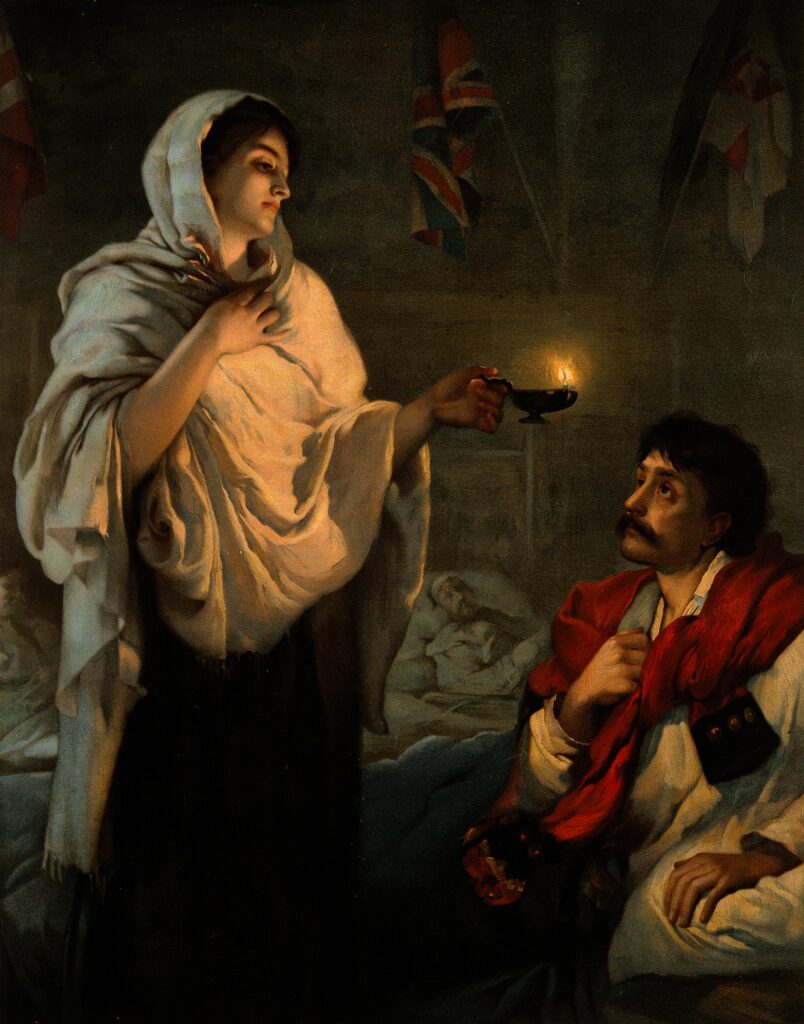
There is, of course, a link between light and healing in our popular imagination. We remember Florence Nightingale as the “lady of the lamp”, laying her gentle hands on the brows of English soldiers seriously injured on Turkish battlefields during the Crimean War. In her 1891 painting, Henrietta Rae portrays Nightingale holding an oil lamp that shines with an intense circle of light, similar to the ball of light that Trump nestles in his hand.
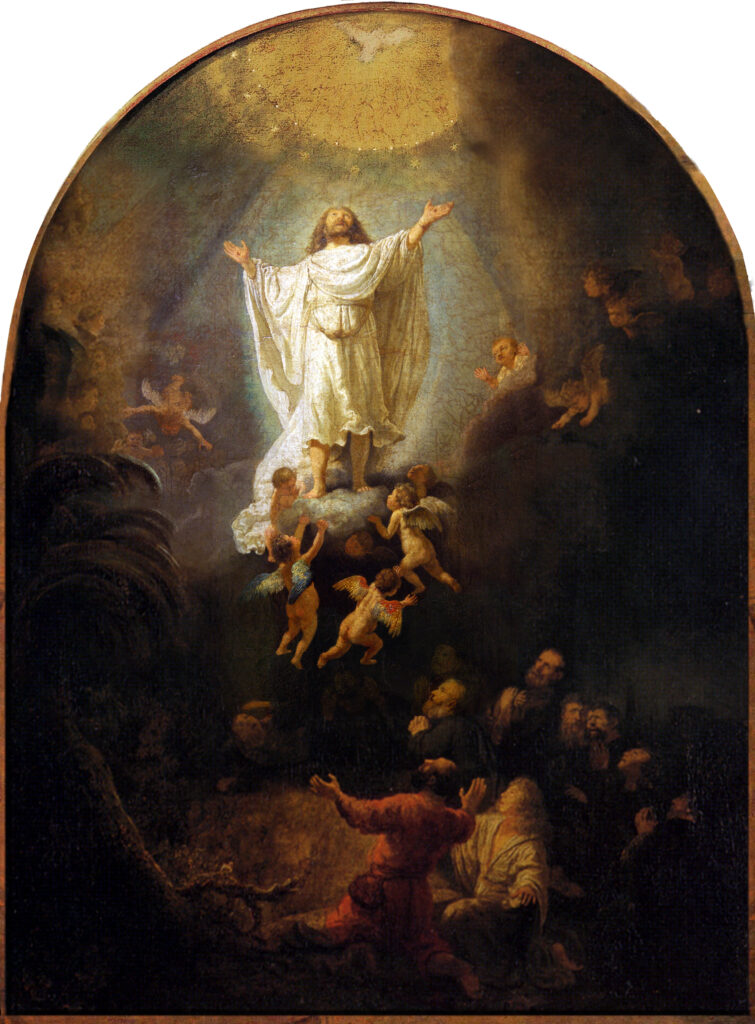
The fact that Trump himself would seem to be the source of light in “AI Jesus”, perhaps the better analogy is Rembrandt’s 1636 painting The Ascension. The light at the top of the painting draws our attention not only to Jesus’s inclined face but also to the wounds in his hands from the crucifixion. In the Christian tradition, after all, it is by his wounds that humanity is healed (Isaiah 53:5).
In “AI Jesus” Trump wears a luminous white gown, rumpled and loose. The style is unavoidably first-century Jerusalem. The red cloak calls to mind the scarlet robe Jesus is forced to wear by Roman soldiers prior to his execution (Matthew 27:28). It also echoes the drape of the redcoat over the shoulders of the soldier in The Lady of the Lamp, suggesting perhaps that AI may have also used the image of Nightingale and the soldier as part of the pictorial “data set” that helped generate “AI Jesus”.
In Rembrandt’s The Ascension, Jesus looks upwards to a dove at the top of the painting, representing the Holy Spirit and divine approval (Matthew 3:16-17). In “AI Jesus”, American eagles and fighter jets replace the dove. Directly above Trump and behind the silhouettes of four floating soldier-like figures, there is a source of radiating light. Doesn’t this also call to mind God’s words of approval at Jesus’s baptism: “This is my Son, whom I love; with him I am well pleased” (Matthew 3:17)? Around Trump, soldiers, veterans, health workers and citizens in the foreground gaze at him with wonder. The suggestion of crowds of people on the steps of government buildings in the background — a nod, perhaps, back to the 6 January 2021 riots at the US Capitol — underscores the pervasive theme of absolute devotion expressed toward this wondrous figure at the centre of the image.
Mother Teresa of Calcutta is said to have recited each day a prayer attributed to John Henry Newman:
Penetrate and possess my whole being so utterly,
that my life may only be a radiance of Yours.
Shine through me, and be so in me
that every soul I come in contact with may feel Your presence in my soul.
Let them look up and see no longer me, but only Jesus!
In “AI Jesus”, we are invited to do the opposite. By using imagery associated with Jesus, we are encouraged to look only at Trump, and to do so with awe. Which is to say, we are invited to engage in worship.
The AI-generated image is a clumsy mash-up of patriotic tropes — complete with flag, fireworks and (incongruously) the Statue of Liberty — and a reckless appropriation of Christian imagery for the purposes of political propaganda.
It gives off a whiff of divinity but retains the element of plausible deniability as to its meaning: this is Trump-as-Jesus; this is not Trump-as-Jesus. But beneath this sleight of hand, the message of “AI Jesus” could hardly be clearer: join these patriots in looking up at Trump with veneration and gratitude, or risk falling victim to the menacing reminders of his unassailable military power.
Danielle Terceiro is a Research Fellow at the Centre for Public Christianity. This article was first published in ABC Religion & Ethics.
Image: Donald Trump via Truth Social. (This image is AI-generated).