 Article
“Shame has to change sides”: that is the mantra that made Gisèle Pelicot, survivor of sexual violence and now feminist icon, instantly memorable. Her new memoir is even more of a marvel. In recounting how she endured abuse that rendered her an “inert, almost dead woman”, she pulls off a miracle – by showing that shame is a grave you can rise from.
It’s a story worthy of the Easter season. Like the Passion of Jesus Christ – where the Latin root of “passion” derives from passio, meaning suffering and endurance – the Passion of Gisèle Pelicot did not end in shame and death. Instead, in an unlikely, wholly surprising turn of events: resurrection.
There are lots of reasons to resist comparing Gisèle Pelicot to Jesus Christ. Pelicot herself would likely reject any link, as would any female victim of male violence. They’d be right to object that comparing a woman’s suffering to that experienced by a man erases the woman concerned and pushes her to the margins of her own story. Normally, I’d agree, but Jesus seems the exception. Hold that thought.
In one crucial respect, the Passion of Gisèle Pelicot aligns with the Passion of Jesus Christ: their shared experience of utter degradation and humiliation.
“Shame beyond shame”
The sickening story of what Gisèle Pelicot suffered is, by now, well known. For years, Pelicot’s then husband drugged and then raped her while she was unconscious, recruited dozens of other men to do the same, and filmed it all for his own sick gratification. That man is now in jail, along with 50 other offenders.
“I was sacrificed on the altar of vice,” she said during the 2024 trial that shocked the world. Indeed, she would not have exaggerated had she described herself as having been crucified: first, in the experience of the abuse and almost ritualised humiliation to which she was subjected; second during the court case itself. There she sat in the same room as the offenders, viewed footage of her unconscious body on screen, experienced herself as a thing passed around by men.
Although entirely innocent, Gisèle Pelicot was shamed by the shame that was rightly theirs.
Shame “sticks to you, it sticks to your skin”, she has since said in interviews, and that shame is a “double sentence, it’s a suffering you inflict on yourself”.
Gisèle’s experience captures something of what the American Episcopal priest Fleming Rutledge describes as “shame beyond shame”, in her book The Crucifixion: Understanding the Death of Jesus Christ. For Rutledge, this is the self-alienation someone experiences when their body or self is turned against them, forcing them to become the unwilling instrument of their own suffering.
“Crucifixion was specifically designed to be the ultimate insult to personal dignity, the last word in humiliating and dehumanising treatment,” Rutledge writes. “Degradation was the whole point.” Any physical agony involved (and there was plenty) was still secondary to the shame of being un-personed, even eliminated from the human race. It was all done publicly, naturally, to expose the victim to widespread scorn and disgrace. This godless death, reserved for slaves and the dregs of society, says Rutledge, was the willing fate of the son of God.
“Ecce homo”
On Good Friday some two thousand years ago, the broken and bloodied body of Jesus was presented to the capricious Roman governor Pontius Pilate. He tells the crowd baying for Jesus’ blood, “ecco homo” or “behold the man”. This expression from the Vulgate, a fourth-century Latin translation of the Bible, became a regular theme of Western Christian art, with Caravaggio, Bosch, Rembrandt, Mantegna, Titian, and Holbein, all depicting the scene.
In these artworks, the often near-naked Jesus is bound, his body bared for public consumption. Exposed to the violence of others, and made completely subject to their will, shame is heaped upon him. He wears a crown of thorns – a mockery of his claim that his “kingdom is not of this world.” In Antonio Ciseri’s 1860 Ecce Homo painting, Pilate gestures extravagantly to the bound Jesus next to him, as if exulting in his total power over the life and death of just another faceless slave. (The photo from the Epstein Files, of Andrew Mountbatten-Windsor on all fours over a woman lying prone on the floor, seems a modern equivalent.)
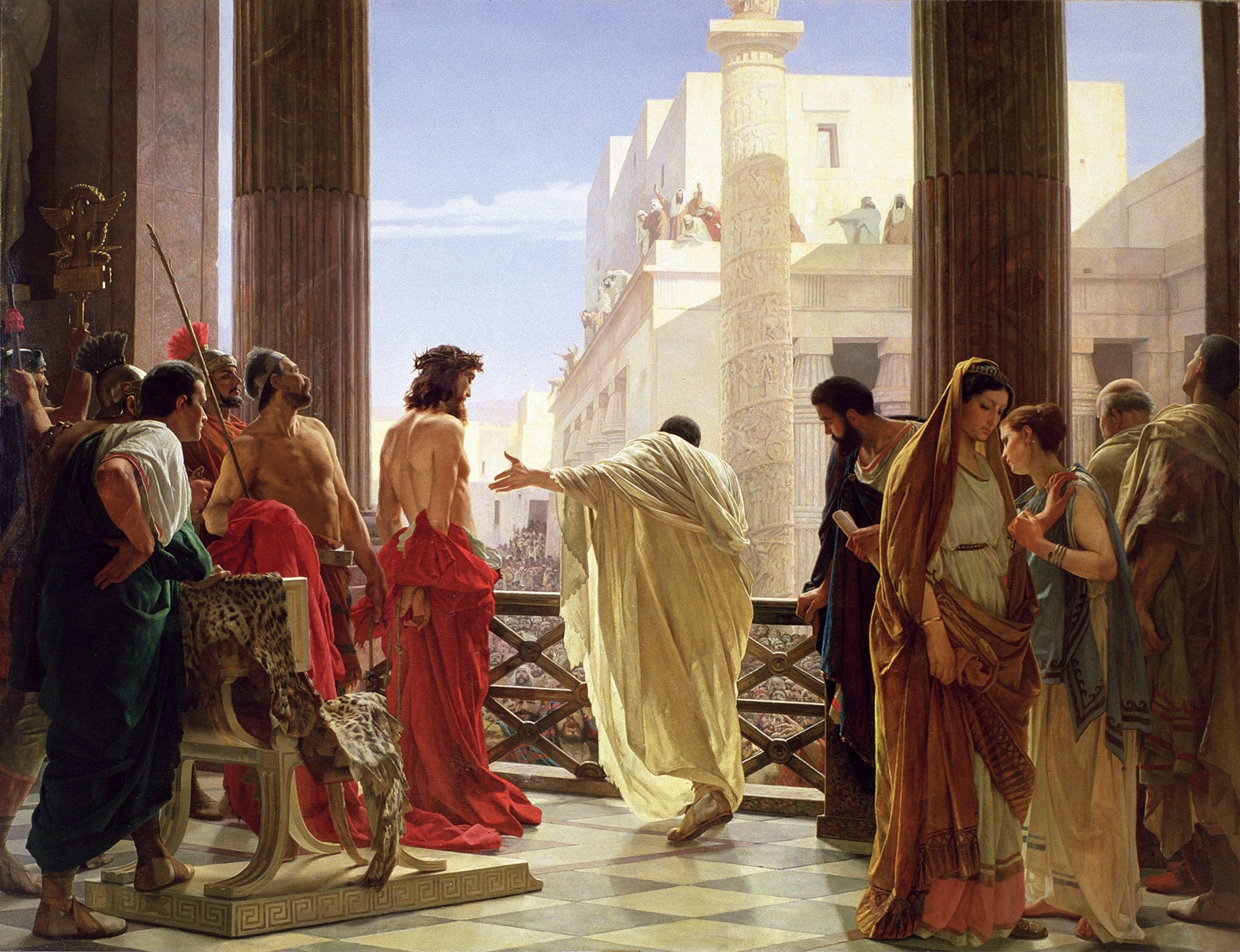
Perhaps this is why Ecce Homo has since become iconic: representative, more broadly, of human suffering. “Behold the man” becomes “behold the human who suffers”.
So, in Ecce Homo with self-likeness behind barbed wire (1948) German painter Otto Dix portrayed himself as Christ in a concentration camp amidst the ruins of the Second World War. The 1928 French silent film The Passion of Joan of Arc (1928) likewise drew direct parallels between Joan and Jesus, featuring extreme close-ups of Joan’s agony during her trial and execution. There is a scene depicting guards mocking and menacing Joan by placing a straw crown on her head. In the biblical passion narrative, Roman soldiers beat up Jesus and then dress him in a royal purple gown. In the Passion of Gisèle Pelicot, her abuser dresses her limp form in lingerie, an obscene parody of love.
In becoming an icon of human suffering, Ecce Homo links the brutalised body of Christ and anyone who has ever suffered. Female victims of male violence, too. For in the Ecce Homo scene, Jesus’ vulnerability is extreme. His body becomes a symbol of unlimited power wielded by another, since it is left completely exposed to the effects of that power. Dwell on these images long enough, and you realise: perhaps Jesus might truly understand “what it feels like for a girl.”
“To shame the strong”
The theological claim that Jesus is both fully human and fully God adds yet another dimension of meaning. In Jesus’ crucifixion, God stands in solidarity with victims, subjects himself to human evil. But this is a two-way street. If God is numbered along with the dead and despised, there remains a trace of God in every victim’s face, and there is no human life so defaced and degraded as to be beyond God’s reach.
This is why the bold declaration of the early Christians, that Jesus rose triumphantly from the dead, has such power, such potential for new life.
The resurrection overturns everything. Victims are vindicated, while victors are vanquished.
In his letters to the early church, the Apostle Paul grapples with the reversal of fortunes enacted by the resurrection on Easter Sunday. “God chose the foolish things of the world to shame the wise”, he writes to the church in Corinth. “God chose the weak things of the world to shame the strong.”
To the believers in Colossae, the Apostle describes reality tilted on its axis. For crucifixion was supposed to proclaim the ultimate power of the crucifiers, their prerogative to make the weak grovel before the strong. Yet the Christian claim is that one particular victim of crucifixion beat them at their own game. “Having disarmed the powers and authorities,” Paul writes, Jesus “made a public spectacle of them, triumphing over them by the cross.”
Shame must change sides, Gisèle Pelicot has long insisted. It is entirely possible that it already did some two millennia ago on that first Easter Sunday, and the effects of that event are still rippling outward.
Perhaps Gisèle Pelicot waiving her right to anonymity in that courtroom is the advance guard of that new world. She did it so that her case could, at least potentially, save other victims of sexual assault and lessen the stigma of shame that often attaches to victims. Also, for the sake of her grandchildren who bear the Pelicot name.
A haunting prospect: keeping the last name of one’s abuser. It turns out that making shame change sides requires a sacrifice: of Gisèle Pelicot’s own privacy and dignity. That is, Pelicot’s “crucifixion” may finally be over, but she continues to suffer by being associated with her abuser. A lifelong cross to bear, but one whose meaning is transformed. Even a mark of shame can become a battle scar of the one who, in the end, prevailed.
As she said in an interview about her decision to remain known, at least publicly, as Gisèle Pelicot: the name of her abuser will be forgotten, but hers will endure.
That claim has form. Of the many thousands of victims of crucifixion, lost to history, we remember one name above all: Jesus Christ.
Justine Toh is Senior Research Fellow at the Centre for Public Christianity. This article was first published in ABC Religion & Ethics.